

AI servers generate concentrated heat inside high-density racks. GPUs, CPUs, memory modules, and power components may remain under heavy load for long periods, making temperature control a key part of system performance and reliability.
Temperature Monitoring Around AI Chips
GPUs and processors are the main heat sources in an AI server. When their temperature rises too quickly, the system may reduce operating frequency, lower computing performance, or initiate a protective shutdown.
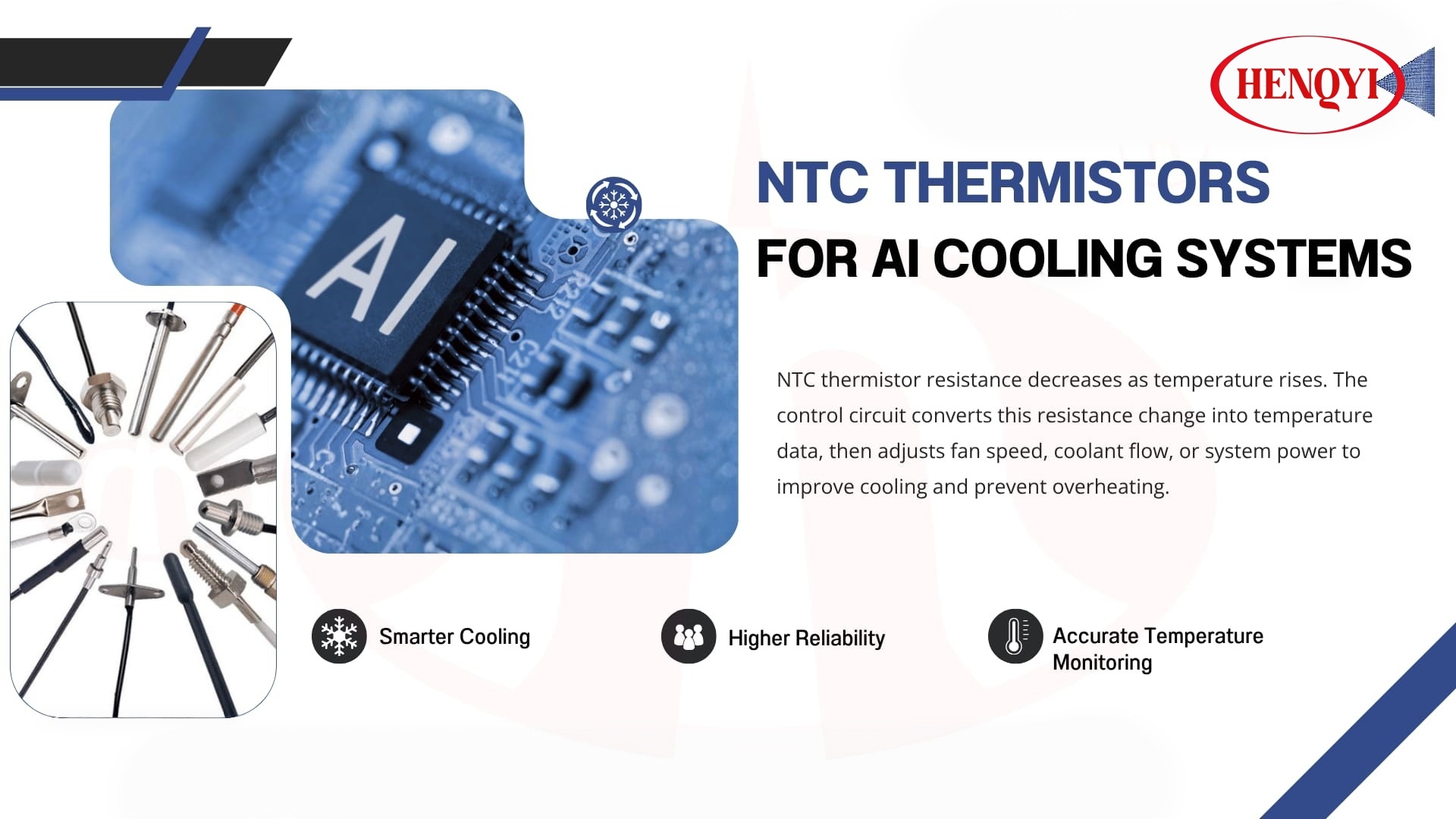
Compact NTC thermistors can be installed near chips, heat sinks, power modules, or cold plates to monitor local temperature changes. The measured data allows the control system to adjust fan speed, coolant flow, computing load, and other cooling parameters before a hot spot develops into a larger problem.
Because NTC thermistors are highly sensitive to temperature changes and available in small package sizes, they are suitable for locations where installation space is limited.
Temperature Sensing in Liquid-Cooling Systems
Liquid cooling is increasingly used in high-power AI servers because it removes heat more directly than conventional air cooling. However, stable operation depends on accurate temperature information throughout the coolant loop.
NTC temperature sensors can be installed at the coolant inlet and outlet, cold plates, manifolds, pumps, and heat exchangers. By comparing the inlet and outlet temperatures, the system can evaluate heat-transfer performance and adjust pump speed or coolant flow.
A sudden temperature increase may indicate insufficient coolant flow, a blocked pipe, pump failure, or poor thermal contact between the cold plate and the processor. Multi-point monitoring helps identify these issues before they affect the entire rack.
Multi‑Point Monitoring for Smarter Cooling
A single temperature measurement cannot represent the thermal condition of an entire AI server. Temperatures may differ significantly between processors, power supplies, coolant pipes, rack air inlets, and exhaust areas.
Using multiple NTC sensors allows the cooling system to distinguish between a local component hot spot, insufficient coolant flow, poor airflow, and rising room temperature. This supports more precise fan and pump control instead of running every cooling component at maximum output.
Smarter temperature control can help reduce unnecessary energy consumption while maintaining stable operating conditions.

Selecting an NTC Sensor for AI Cooling
The sensor should be selected according to its installation location and operating environment. Important factors include nominal resistance, B value, tolerance, response time, temperature range, probe structure, insulation, cable length, and connector type.
Sensors used in liquid‑cooling systems may require moisture‑resistant packaging and compatibility with the surrounding coolant and materials. Sensors installed near processors or power modules may need a compact structure and fast thermal response.
SHENZHEN HENQYI provides NTC thermistors and customized temperature sensor solutions for AI servers, liquid‑cooling equipment, power supplies, UPS systems, and data‑center applications.