

Enhancing E‑Cigarette Performance and Safety with NTC Thermistors
As e‑cigarette devices evolve with higher power output, refined temperature control, and more stringent safety standards, temperature management has become a critical aspect of entire system design. Precise temperature monitoring not only affects the atomization effect but also directly relates to device safety and the lifespan of critical components.
In e‑cigarette systems, NTC thermistors are widely applied in temperature detection and control due to their stable temperature perception characteristics, small size, and rapid response. By real‑time monitoring of temperature changes at key locations, NTC thermistors help the system achieve stable heating control while supporting battery protection and abnormal temperature warnings.
SHENZHEN HENQYI has long focused on the research, development, and manufacturing of NTC thermistors, providing temperature detection solutions suitable for compact electronic devices.
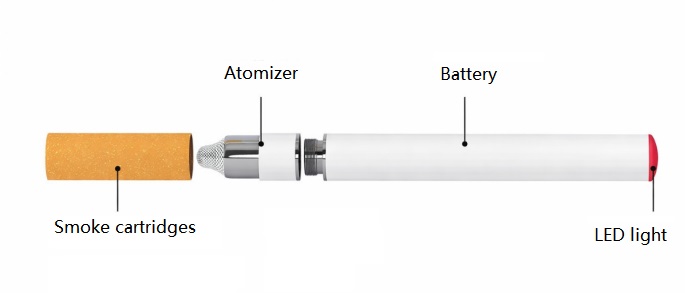
Temperature Management Needs of E‑Cigarette Systems
The working principle of an e‑cigarette is to convert electrical energy into thermal energy via a heating element, causing the e‑liquid to atomize within a certain temperature range.
The level of temperature control directly affects the following aspects:
- Atomization efficiency and consistency of the inhale taste.
- Prevention of burnt taste or irritating odors due to overheating.
- Extension of the lifespan of the atomization core and oil‑guiding materials.
- Ensuring the safe operation of batteries and power devices under high‑load working conditions.
Therefore, modern e‑cigarette devices typically require real‑time temperature perception, rapid signal feedback, and dynamic power adjustment capabilities, thereby forming a complete temperature management system.
The Role of NTC Thermistors in E‑Cigarettes
NTC thermistors possess the characteristic of decreasing resistance value as temperature increases; their temperature‑resistance curves are stable with good repeatability, making them very suitable for continuous temperature monitoring and closed‑loop control.
In e‑cigarette systems, NTC thermistors typically undertake the following functions:
- Detection of temperature changes at critical locations.
- Provision of stable temperature signals for the control chip (MCU).
- Support for power adjustment and safety protection logic.
Typical Application Scenarios
Atomization System Temperature Detection
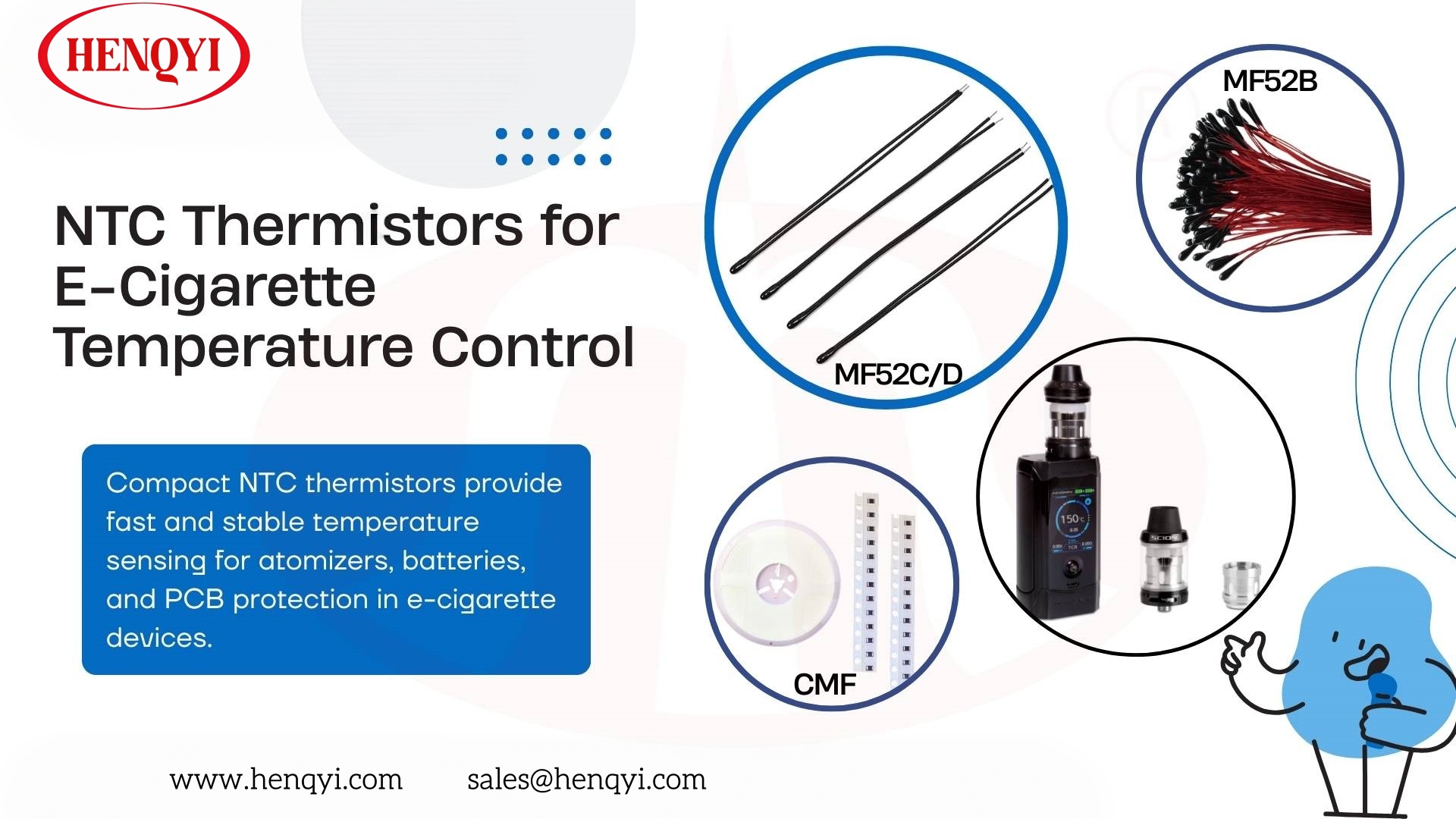
In e‑cigarette devices supporting Temperature Control mode (TC Mode), small‑sized SMD NTC thermistors (such as 103F3435 in 0402 / 0603 packages) are typically installed near the atomization component, for example:
- Around the atomization core.
- Near the heating plate.
- At locations with thermal coupling to the heating component.
- By collecting temperature changes in real‑time,
the system can achieve: - Dynamic adjustment of output power.
- Maintenance of a stable atomization temperature.
- Reduction of performance differences between different batches of products.
Compared to the method of calculating temperature solely through changes in coil resistance, an independent NTC temperature detection path can significantly enhance the accuracy and reliability of temperature control.

Dry Burn Prevention and Abnormal Temperature Rise Monitoring
When e‑liquid is insufficient, oil guiding is obstructed, or abnormal usage occurs, the temperature in the atomization area may rise rapidly within a short time.
NTC thermistors (such as MF52B 103F3435) possess:
- Relatively fast thermal response speed.
- Stable temperature‑resistance characteristics.
- Good thermal cycle consistency.
By real‑time monitoring of temperature changes, the system can identify abnormal temperature rise conditions, thereby reducing the risk of dry burning, material carbonization, or taste deterioration.
Battery and PCB Temperature Monitoring
E‑cigarette devices typically use high‑energy‑density lithium batteries, which are very sensitive to temperature during charging, discharging, and high‑power output processes.
NTC thermistors (such as MF52C / MF52D 103F3435) are often used for:
- Battery surface temperature detection.
- Internal temperature monitoring of the battery compartment.
- Temperature rise detection of critical power devices on the PCB.
This temperature data can support:
- Charging over‑temperature protection.
- Temperature limits during the discharge process.
- Improvement of the overall device operating safety margin.
Glass Encapsulation: The Ultimate Moisture Barrier
SHENZHEN HENQYI's MF58 series solves these issues through high‑integrity glass encapsulation.
- Hermetic Protection: The sensing element is fully shielded from moisture, ensuring stable performance in 100% humidity.
- Operational Excellence:
- Insulation Resistance: 500 MΩ at 500V DC.
- Thermal Resilience: After 1,000 hours at 250°C/482°F, resistance drift remains within a remarkable 2%.
- Endurance: Capable of withstanding up to 100,000 high‑low temperature cycles.
Fast Response for Precise PID Control
Cooking consistency depends on how fast a sensor reacts to change. The MF58 features a 12‑second thermal time constant, allowing the oven’s control system to:
- Detect rapid heat spikes during startup.
- Transition smoothly from full‑power heating to stable PID modulation.
- Eliminate temperature "overshoot," protecting delicate fermented dough and high‑end proteins alike.

Advantages of NTC Thermistors in Small Electronic Devices
E‑cigarette devices have compact structures and frequently experience heating and cooling cycles during operation. NTC thermistors have the following advantages in such applications:
- Small package size, suitable for compact structural designs.
- Stable temperature‑resistance characteristics, beneficial for product consistency.
- Fast response speed, suitable for pulse heating control.
- Maintaining good long‑term stability even under repeated thermal shock environments.
- Mature mass production processes, suitable for large‑scale production applications.
As e‑cigarette devices continue to develop towards intelligence and high safety standards, stable and reliable temperature monitoring technology becomes increasingly important. NTC thermistors can provide accurate temperature feedback for atomization systems, battery modules, and control circuits, and are one of the critical components in e‑cigarette temperature management systems. With stable performance and flexible packaging forms, NTC thermistors will continue to play an important role in small electronic devices such as e‑cigarettes.